Published
SCC contributes data to new IBA report on third-party participation in investment arbitration
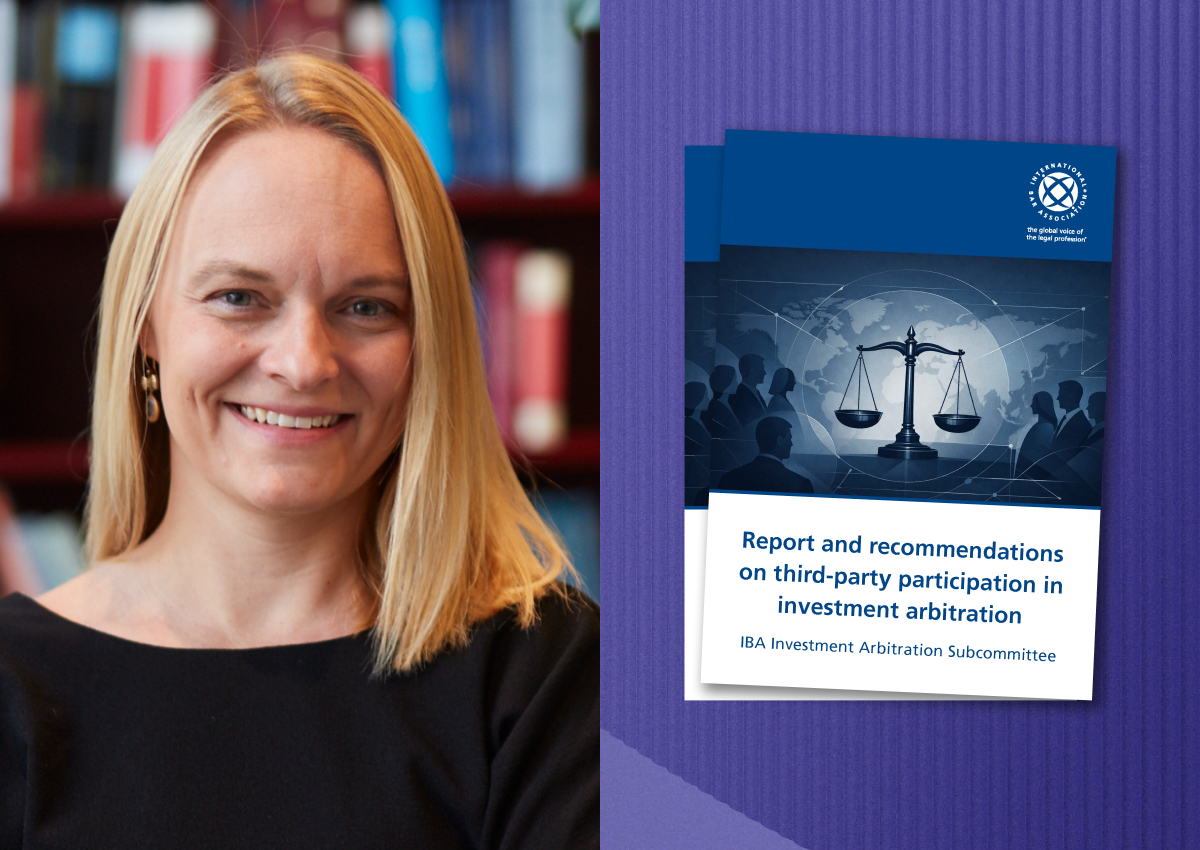
The International Bar Association (IBA) has published its Report and Recommendations on Third-Party Participation in Investment Arbitration, a comprehensive study examining the growing role of third-party participation (TPP) in investor-state dispute settlement (ISDS). SCC Secretary General Caroline Falconer contributed input to the report's underlying research, including data and statistics from SCC's investment arbitration caseload. The report is set to become an important reference point for practitioners, institutions, and policymakers active in the field.
About the report
The report was authored by the IBA Investment Arbitration Subcommittee and provides recommendations that aim to promote clarity and consistency in managing TPP in ISDS. It addresses one of the most debated procedural developments in contemporary investment arbitration: the participation of third parties, whether as amicus curiae or as non-disputing treaty parties (NDTPs), in investor-state proceedings. Drawing on empirical data gathered from those arbitral institutions that collectively administer the majority of investment arbitrations, including ICSID, the PCA, SCC, and the ICC, as well as from publicly available information in other ad hoc arbitrations, the report maps the development of TPP applications and examines the legal frameworks, procedural requirements, and substantive criteria that govern such participation.
SCC’s contribution
Caroline Falconer contributed input to the report’s underlying research. This included providing data from SCC’s investment arbitration caseload. The report confirms that eleven TPP applications, representing approximately 5.2 per cent of the total, were made in SCC arbitrations. All eleven applications were granted, with the data revealing that denials of TPP applications featured only in ICSID and PCA proceedings, with no denials recorded in SCC arbitrations. This strong record reflects SCC’s transparent and well-established procedural framework for managing third-party participation, as set out in Appendix III of the SCC Arbitration Rules (2023).
Seven recommendations for clarity and consistency
The report puts forward seven recommendations aimed at promoting a more harmonised and principled approach to third-party participation in investment arbitration:
- Disclosure: Tribunals and ad hoc committees should require all third-party applicants to disclose their identity, ownership and control, all sources of funding and assistance for the preparation of the submission, and any direct or indirect affiliation, connection, or financial link with any disputing party.
- Party consultation: Tribunals and ad hoc committees should invite comments from the disputing parties on any application or ex officio invitation for third-party participation in a proceeding.
- Ex officio participation: Where tribunals are considering inviting third-party participation on their own initiative and the applicable rules are silent, they may consider exercising this power, subject to deferring to parties who intend to issue such an invitation themselves, and to considering whether another avenue, such as a tribunal-appointed expert, is more appropriate.
- Assistance to the tribunal: When considering whether a third-party applicant with a significant interest in the subject matter can assist the tribunal on a matter within the scope of the dispute, the tribunal may wish to consider the expertise of the proposed participant or the uniqueness of their perspective as distinct from that of the disputing parties.
- Significant interest: When assessing whether an applicant has a significant interest in the subject matter of the case, tribunals should consider whether the applicant has a direct stake in the dispute’s subject matter, a connection with the dispute through mandate and action, and/or a unique and compelling interest in the legal principles at issue.
- Timetables: Tribunals and ad hoc committees should establish clear timetables for third-party participation, indicate an estimated date by which they anticipate rendering a decision on an application, and undertake all efforts with the disputing parties to ensure that timetables are made publicly available.
- Access to documents: In the absence of express provisions in the relevant investment agreement and/or rules, tribunals and ad hoc committees should provide third parties with access to the pleadings, subject to the protection of any confidential or sensitive information, and may consider allowing access to other arbitral documents where the third parties can demonstrate that such access is justified and essential to the preparation of their submissions.