SCC Practice Note: Insurance-Related Arbitrations at the SCC (2014-2025)
Authors: Jake Lowther, Pierre de Gottrau1
Table of contents
Executive Summary
This practice note examines 51 insurance-related arbitrations administered by the SCC from January 2014 to December 2025. Key findings include:
- Caseload and Procedures: The majority of cases (64 per cent) were conducted under the Arbitration Rules, with 27 per cent under the Rules for Expedited Arbitrations. Cases under the Arbitration Rules averaged 11 months to resolution, whilst expedited cases averaged 3 months.
- International Character: International cases represented 37 per cent of the caseload, nearly doubling from 20 per cent in the 2002-2013 period. Parties originated from 16 different jurisdictions across Europe and beyond.
- Dispute Types: Recourse claims against third parties dominated (38 per cent), followed by insurance coverage disputes (23 per cent). M&A disputes decreased significantly from 16 per cent to 4 per cent compared to the earlier period.
- Value and Efficiency: The total amount in dispute reached EUR 278 million. Swedish law governed 91 per cent of cases, with Stockholm as the seat in 90 per cent. English was the language of proceedings in 39 per cent of cases, and exclusively in the most recent cases registered.
- Multi-party Disputes: 16 per cent of cases involved more than two parties, demonstrating the importance of the SCC’s procedural framework for joinder and consolidation.
Background
The SCC Arbitration Institute (“SCC”) is one of the world’s leading dispute resolution institutions with over 100 years of history, serving parties of over 40 nationalities annually. As a pioneer in innovation, the SCC was among the first institutions to develop a digital case management platform, and procedural innovations such as the emergency arbitrator mechanism.
The SCC has a long history in handling insurance related disputes under both sets of the SCC’s arbitration rules, i.e. the Arbitration Rules of the SCC (the “Arbitration Rules”) and the Rules for Expedited Arbitrations of the SCC (the “Rules for Expedited Arbitrations”) (jointly the “SCC Rules”). Previously, the SCC had specific Insurance Arbitration Rules, which were designed to offer flexibility by incorporating both the Arbitration Rules and the Expedited Rules. The Insurance Arbitration Rules have since been phased out and instead this inherent flexibility has been transposed into the SCC’s dispute resolution clauses, with the SCC making several combination clauses available to arbitration users. These clauses are now widely used, with recent data showing that 36 per cent of analysed cases administered under the Rules for Expedited Arbitrations initiated pursuant to such a clause.2
Moreover, the SCC Rules are well suited to address the fact that insurance-related arbitrations frequently involve multiple contracts and parties, as the SCC Rules since 2017 have expressly allowed for joinder of additional parties, and handling of multiple contracts in a single arbitration, and since 2007, the consolidation of arbitrations. Since 2023, the SCC’s power to decide on consolidation has been expanded (more about this below). These innovations have helped to reduce duplication and cost, as well as improve efficiency.
This practice note examines the SCC experience with insurance-related arbitrations from January 2014 to December 2025. It builds on an earlier report that covers the period of 2002-2013.3 Since 2013, both the overall caseload at the SCC and the number of insurance-related arbitrations have grown significantly.4 As mentioned, the SCC Rules have also undergone revisions, including to the Schedule of Costs.
This practice note provides insights into various aspects of these insurance-related arbitrations, including the types of disputes arising from the insurance business, the different arbitration rules applied, the seat of arbitration, the governing law chosen by the parties, and the language used in the proceedings. It also compares the two reports, providing insights into the trends observed over the years.
Methodology
Cases examined
This practice note adopts a “broad approach” to define and filter cases falling within the category of “insurance-related arbitration”. This approach includes cases where at least one party was an insurance company. As discussed further in this report, although the majority of cases involved recourse claims against a third party, the research also encompassed cases relating to insurance coverage disputes, M&A transactions, shareholders’ agreements, cooperation and distribution agreements, as well as other types of disputes. This resulted in a total data pool of 51 cases.
SCC services used in insurance-related arbitration
Whilst the search for insurance-related cases covered the full range of SCC services, the cases identified and included in this analysis were those administered under the Arbitration Rules, the Rules for Expedited Arbitrations, Mediation, Emergency Arbitrator proceedings, and ad hoc proceedings, in which the SCC served as appointing authority or provided other types of administrative services.
International and domestic disputes
In line with the SCC’s standard practice, this practice note distinguishes between international and domestic disputes. In this regard, international cases are proceedings which involve at least one party that is not resident in Sweden, or, in the case of a legal person, that is not registered in Sweden. A case will be classified as a domestic dispute where all parties involved in the proceedings are either residing or registered at an address in Sweden.
The Numbers on the SCC’s Insurance-related Arbitrations
Breakdown of SCC services used in insurance-related arbitrations
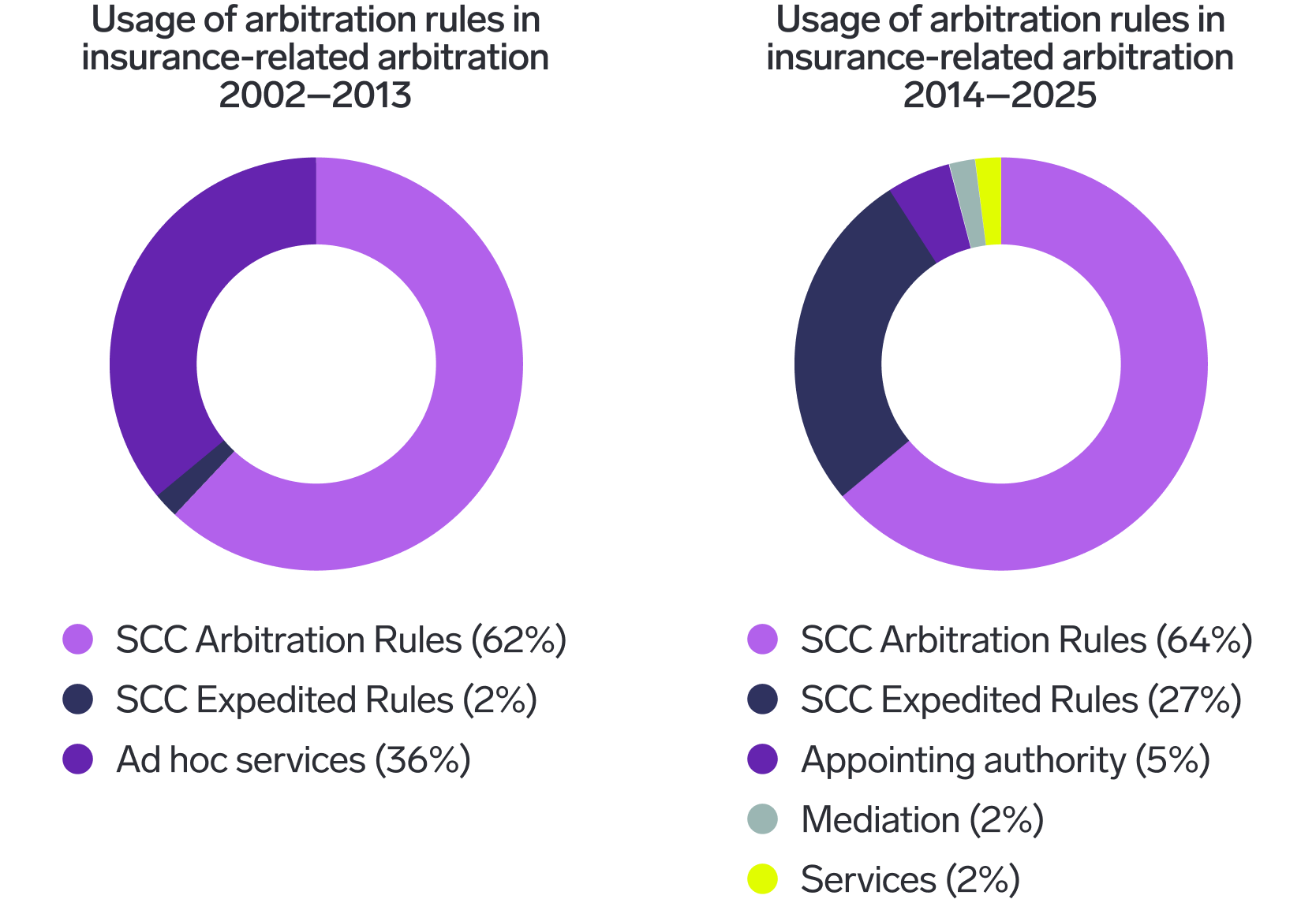
Most disputes related to insurance brought before the SCC have been conducted under the Arbitration Rules (65 per cent). Of these, the majority (62 per cent) were heard by an Arbitral Tribunal comprised of three arbitrators, whilst 38 per cent were decided by a sole arbitrator. A further 27 per cent of insurance-related arbitrations were conducted under the Rules for Expedited Arbitrations, which provide for a sole arbitrator only. Finally, the appointing authority function accounts for 4 per cent of the cases, whilst mediation and other services (e.g., fund holding5) each represent 2 per cent.
Usage of arbitration rules in insurance-related arbitration 2014–2025
International vs domestic cases
An analysis of the SCC insurance caseload demonstrates the less international character of insurance-related arbitrations over the period. International cases, i.e. cases where at least one or all of the parties were non-Swedish, represent 37 per cent of the total, with parties from Austria, Barbados, Belgium, Cyprus, Denmark, England, Finland, Germany, Ireland, Latvia, Netherlands, Norway, Poland, Romania, Russia and Switzerland. Domestic cases, where all parties are resident or registered in Sweden, comprise the remaining 63 per cent.
Recent years have seen a greater internationalisation of the SCC’s cases. For example, in 2024, the SCC registered 204 new cases. Of these, 51 per cent were international disputes and 49 per cent were domestic. Of the cases that were administered under the SCC Arbitration Rules, 65 per cent were international and 35 per cent were Swedish. It is expected that future datasets will reflect this increased internationality.
Parties to the cases
Insurance companies featured prominently in the cases analysed. In over half of cases (53 per cent), an insurance company appeared as the claimant against a non-insurance respondent. Just under a third of cases (30 per cent) involved an insurance company as respondent against a non-insurance claimant. In the remaining 17 per cent of cases, both parties were insurance companies.
Amount in dispute
The total amount in dispute across all insurance-related arbitrations reached EUR 278,131,553. Cases under the Arbitration Rules had a total value of EUR 273,975,866 with an average per case of EUR 8,561,746, whilst cases under the Rules for Expedited Arbitrations had a total value of EUR 2,002,163, with an average per case of EUR 200,261. Finally, the only Mediation case had an amount in dispute of EUR 2,153,524.
Duration of cases
The insurance-related cases analysed and decided under the Arbitration Rules have taken an average of 11 months to resolve, whilst cases under the Rules for Expedited Arbitrations were resolved in 3 months in average. For comparison, in 2024, 63 per cent of all awards under the Arbitration Rules were rendered within 12 months after referral to the Arbitral Tribunal. In cases under the Rules for Expedited Arbitrations, 92 per cent of all awards were rendered within 6 months. The data demonstrates that the average insurance-related arbitration is resolved more swiftly than the general average at the SCC.
Types of disputes
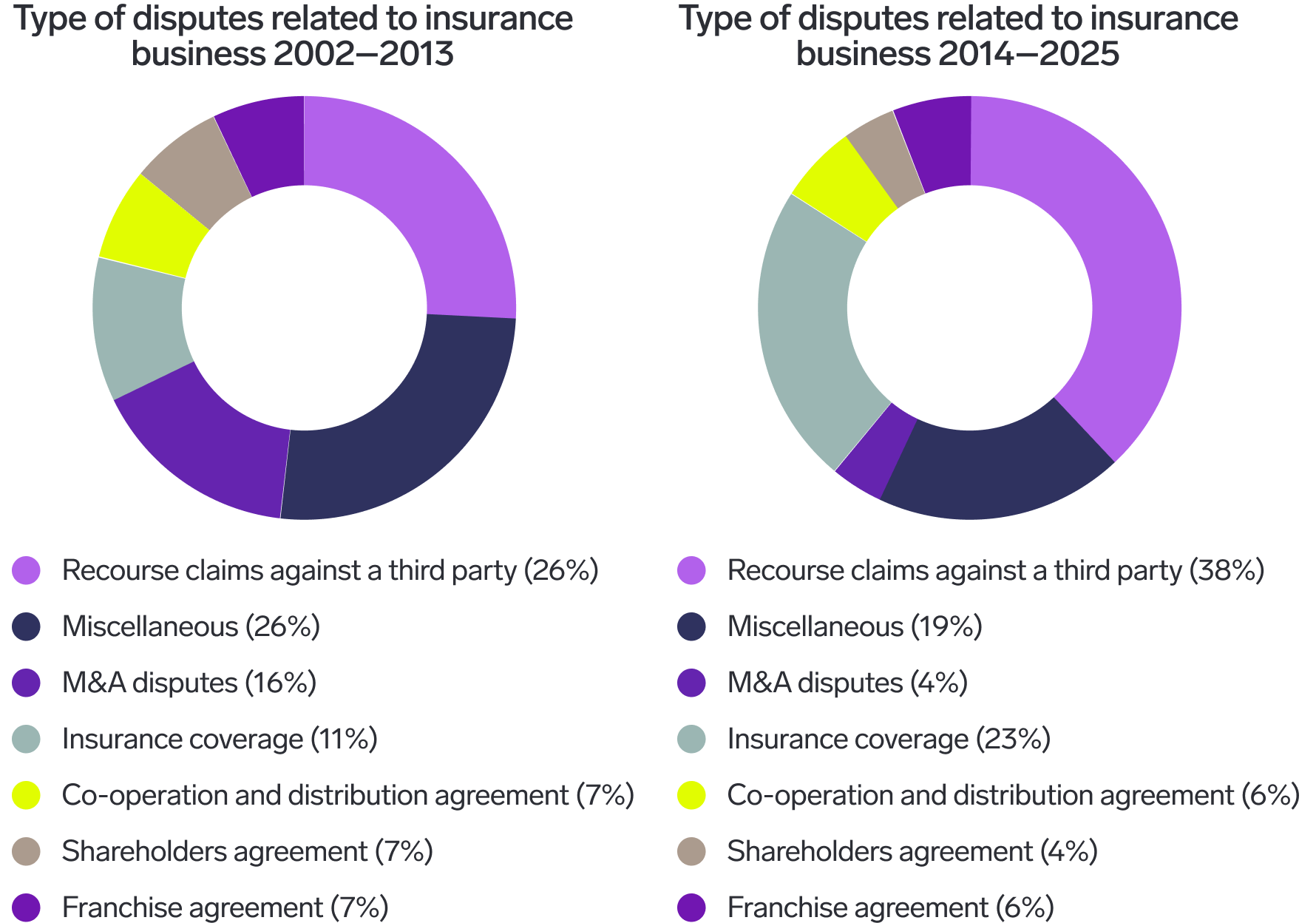
The review of the SCC caseload shows that disputes related to insurance businesses include a wide range of legal and factual issues. The most common dispute concerned recourse against a third party, accounting for 38 per cent of the cases. Disputes concerning insurance coverage accounted for 23 per cent, while 4 per cent of the arbitrations concerned disputes related to mergers and acquisitions (M&A) within the insurance industry. Disputes related to insurance also included co-operation and distribution agreements (6 per cent), shareholders’ agreement (4 per cent) and disputes regarding franchise agreements (6 per cent). The group of miscellaneous insurance disputes at the SCC, accounting for 19 per cent of the insurance-related arbitrations, include mostly contractual disputes.
Types of disputes arising from insurance-related arbitration 2014–2025
Applicable law
An analysis of the insurance-related arbitrations reveals that when it comes to the choice of applicable law, the parties have a clear preference for Swedish law, which governs 91 per cent of cases. As Prof. Christina Ramberg has stated, “Swedish contract law offers international commercial parties a combination of neutrality, accessibility, and commercial pragmatism. Its alignment with the UPICC means it reflects internationally recognised best practices in commercial contracting.”6 This reputation may in part explain the popularity of Swedish law in the insurance-related arbitrations despite their international character and the prevalence of English as the language of the proceedings.
In the remaining insurance-related arbitrations, the parties had chosen ad hoc procedures (5 per cent), English law (2 per cent), and Latvian law (2 per cent).
Governing laws in insurance-related arbitration 2014–2025
Seat of arbitration
As for the seat of arbitration, Stockholm dominates with 90 per cent of cases, although Gothenburg accounts for 7 per cent and Malmö for the remaining 3 per cent. This is in line with the SCC’s general caseload, in which the majority of cases are seated in Sweden, with the majority of these seated in Stockholm.
Language
As for the language used in these insurance-related arbitrations, Swedish has been more common over the period. Swedish was the language in 61 per cent of the cases, with English the language of the proceedings in the remaining 39 per cent of cases. This aligns with the finding that domestic cases represented the majority of insurance-related arbitrations over the period (63 per cent). However, it is noteworthy that, in the last two years, only cases taking place in English have been registered. This conforms to the increasingly international character of the SCC’s caseload.
Issues Related to Multi-contract and Multi-party Disputes
The SCC’s experience with insurance-related arbitrations demonstrates that these arbitrations often involve more than one contract and or constitute multi-party disputes. Indeed, 16 per cent of the insurance-related arbitrations conducted at the SCC involved more than two parties.
The SCC mechanism for appointment of arbitrators in multi-party arbitration is set out in Article 17(5) of the Arbitration Rules and tailored to avoid issues that can potentially arise in multi-party arbitrations that are not governed by similar rules.7 This article provides that where there are multiple claimants or multiple respondents and the Arbitral Tribunal is to consist of more than one arbitrator, the parties on each side shall jointly appoint an equal number of arbitrators. If either side fails to make such joint appointment, the Arbitration Rules provide that the Board may appoint the entire Arbitral Tribunal.8
Moreover, the context of multi-contract and multi-party disputes raises the need to join parties, to handle multiple contracts in one arbitration, and to consolidate proceedings. Since 2017, the SCC Rules have been well suited to address and handle the issues that can arise in this context.
The adoption of the SCC Rules in 2017 entailed a revision of the procedure in respect to the consolidation of arbitrations, giving the SCC increased powers to consolidate cases where the parties’ do not agree on consolidation. The current version is contained in Article 15 of the SCC Arbitration Rules 2023. Under Article 15(1), the Board has the power to consolidate a newly commenced arbitration with an ongoing arbitration in three situations:
- where the parties’ consent to consolidation;
- where all claims fall under the same arbitration agreement; or
- where claims are brought under multiple arbitration agreements, provided that the relief sought stems from the same transaction or series of transactions and the Board deems the arbitration agreements to be compatible.
Before making its decision on consolidation, the Board will consult with the parties and the Arbitral Tribunal (Article 15(2)). This ensures the flexibility in the application of the SCC Rules, ensuring that all stakeholders’ views are taken into account, without compromising on certainty in the case’s administration.
Comparison with the 2002-2013 practice note
International vs domestic cases
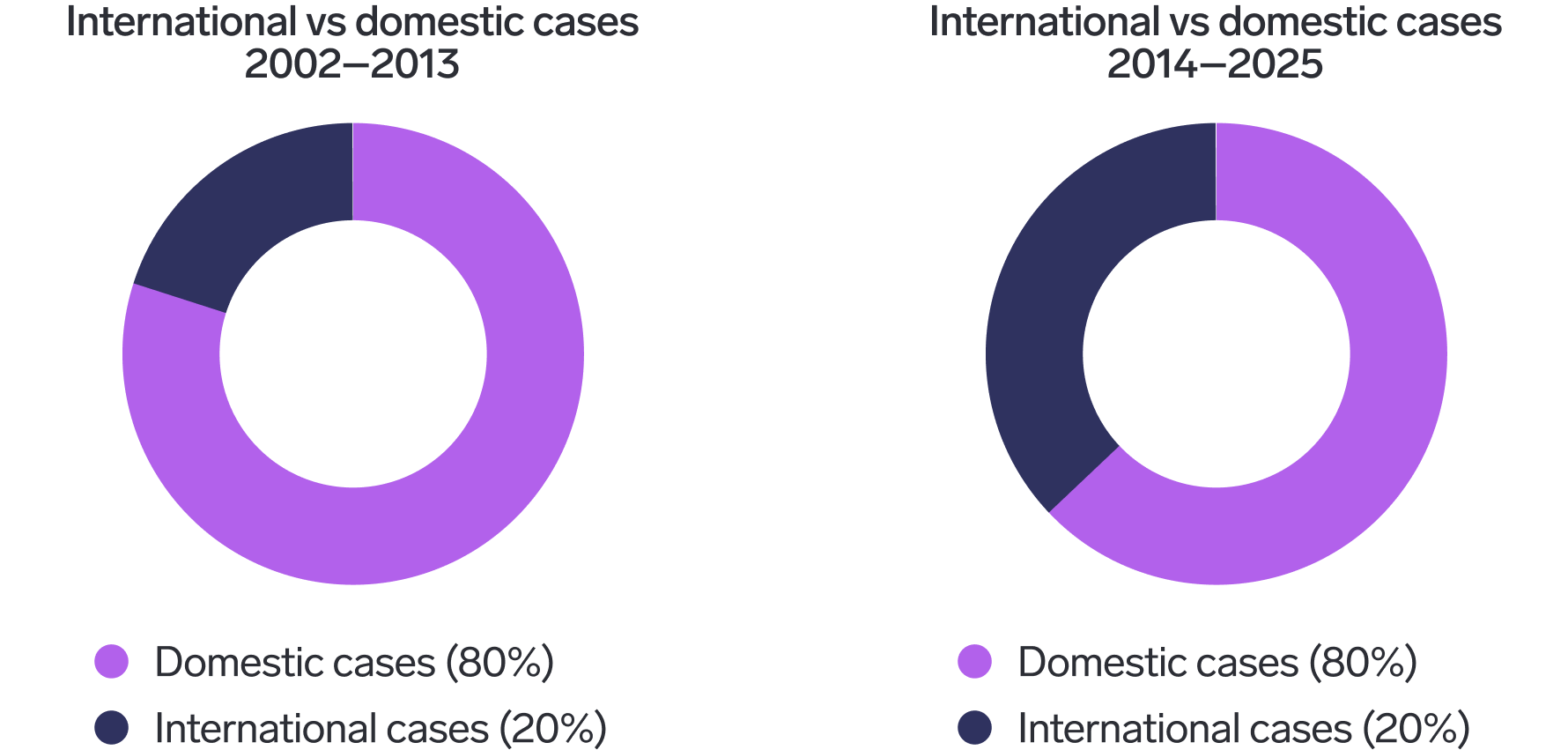
When comparing the data from each of the SCC’s practice notes on insurance-related arbitrations, there is a dramatic shift towards internationalization. The proportion of international insurance-related arbitrations almost doubled (from 20 per cent to 37 per cent), an 85 per cent increase in percentage terms. This indicates that insurance-related arbitrations administered by the SCC have become significantly more international over time, which reflects the internationalisation of the SCC caseload more generally.
Type of disputes
When comparing the types of disputes most commonly seen in each of the data sets, it is clear that disputes concerning recourse against a third-party have become dominant (increasing from 26 per cent to 38 per cent). Meanwhile, M&A disputes have decreased significantly (from 16 per cent to 4 per cent). This suggests dynamic shifts in the nature of insurance-related arbitrations brought to the SCC in the intervening period.
SCC Rules and services
Interestingly, when comparing the datasets between each of the practice notes, two findings emerge in respect to the applicable rules. First, that the proportion of cases initiated under the Arbitration Rules remains almost identical (between 62 and 64 per cent). Secondly, there has been a clear increase in the use of arbitration using the Rules for Expedited Arbitrations with 27 per cent compared to 2 per cent the previous period. And finally, there has been a substantial reduction in the use of ad hoc services.
Conclusion
In general, the SCC’s experience with insurance-related arbitrations from January 2014 to December 2025 demonstrates an evolution, rather than revolution, from the earlier 2002-2013 period. It is clear that the cases have become markedly more international, with insurance-related arbitrations involving at least one non-Swedish party from 20 per cent to 37 per cent of the caseload, reflecting the SCC’s global standing.
Moreover, the nature of disputes has transformed considerably, with disputes concerning recourse against a third-party emerging as the dominant category (rising from 26 per cent to 38 per cent), whilst M&A claims have decreased from 16 per cent to 4 per cent.
Swedish cases comprised 63 per cent of the caseload. Yet English is the language used in 39 per cent of proceedings, and exclusively in the SCC’s most recently registered insurance-related arbitrations. This is marginally higher than the number of international cases (37 per cent). This underscores the growing international character of the modern insurance business and the SCC’s caseload.
Finally, multi-party disputes remain a defining feature, involving 16 per cent of cases. Claims based on more than one contract is another common feature. The SCC’s enhanced procedural framework, including provisions for joinder, consolidation, and emergency arbitrator proceedings has proven well-suited to address the complexities inherent in insurance-related arbitrations.
The data presented in this practice note confirms that the SCC has successfully adapted to the evolving needs of the global insurance industry, whilst maintaining its reputation for efficiency, neutrality, and commercial pragmatism.
Notes
1 Jake is a dual-qualified lawyer (Australia & Sweden) and Specialist Counsel at the SCC. Pierre is a former Intern at the SCC.
2 Lowther, Nizzi and Delac, Costs of arbitration and apportionment of costs under the SCC Rules (October 2024), p. 10, https://sccarbitrationinstitute.se/wp-content/uploads/2025/01/report_costs_of_arbitration_final-2.pdf.
3 Erik Mårild, “SCC Practice Note: The SCC Experience of Insurance Disputes,” https://sccarbitrationinstitute.se/wp-content/uploads/2024/12/the-scc-experience-of-insurance-disputes_marild.pdf.
4 SCC, 2017-2025 Statistics, https://sccarbitrationinstitute.se/en/about-scc/scc-statistics/.
5 For further information, see the SCC Fund holding services, https://sccarbitrationinstitute.se/en/our-services/other-services/fund-holding-services-at-the-scc-arbitration-institute/.
6 SCC Spotlight Talk: Christina Ramberg, https://sccarbitrationinstitute.se/en/news/scc-spotlight-talk-christina-ramberg/.
7 Should one side in a multi-party arbitration be given the opportunity to choose its arbitrator, but not the other side, potential issues may arise. See for example Bernard Hanotiau, Complex Arbitrations: Multi-party, Multi-contract and Multi-issue – A comparative study, Second edition, (Kluwer Law International 2020), Wolters Kluwer, 364-366 and Nathalie Voser, Multi-party Disputes and Joinder of Third Parties in Albert Jan van den Berg (ed), 50 Years of the New York Convention: ICCA International Arbitration Conference, ICCA Congress Series, 2009 Dublin Volume 14 (Kluwer Law International 2009) 343 – 410, at 361.
8 The procedure for the appointment of a three-member tribunal in multi-party arbitrations does not apply in arbitrations conducted under the Rules for Expedited Arbitrations. Under Article 17 of the Rules for Expedited Arbitrations, the arbitration shall be decided by a sole arbitrator. Article 18 provides that the parties may agree on a procedure for appointing the arbitrator or, failing such agreement, shall be given ten days to jointly appoint the arbitrator. If the parties cannot agree, the Board will appoint the arbitrator.