SCC Report: Disputes involving German, Austrian, and Swiss (“DACH”) Parties (2015-2025)
Author: Jake Lowther1
Table of contents
Executive summary
Germany, Austria, and Switzerland (together, the “DACH” region) constitute one of the SCC Arbitration Institute’s (“SCC”) most significant sources of users outside the Nordics. In 2025, exactly half of the SCC’s 213 registered cases were international. The 19 DACH cases registered that year alone accounted for roughly 18 per cent of the SCC’s international caseload.2
This report on disputes involving DACH parties in cases administered by the SCC (“Report”) examines 170 arbitrations administered by the SCC between January 2015 and December 2025 involving at least one party from Germany, Austria, or Switzerland. It presents empirical data on the characteristics of these cases, including their sectoral composition and evolution over the decade, with particular attention to the German market.
Key findings include:
- Caseload: A total of 170 SCC cases involving a DACH party were registered between 2015 and 2025. The pace of registrations has increased in recent years, from an average of 15 cases per year between 2015 and 2019 to 23 cases in 2024 and 19 in 2025.
- Sector distribution: Retail and consumer products (21 per cent) and energy (18 per cent) lead the caseload over the full decade. Technology, automotive, and mining/metals have each gained ground between 2015-2019 and 2020-2025, consistent with the priority accorded to energy transition and advanced manufacturing in the German-Swedish trade relationship.
- Disputed value: The aggregate recorded amount in dispute in DACH cases was approximately EUR 10.79 billion. This figure is driven substantially by three exceptionally high-value cases. Excluding these, the remaining 160 cases total approximately EUR 3.06 billion, with an average of EUR 19.1 million and a median of EUR 2.26 million per case.
- Applicable law and seat: Swedish law applied in 52 per cent of cases, and Stockholm was the seat of arbitration in 78 per cent. Sweden therefore remains central in cases from the DACH region.
- Counterparties: Nordic parties appear on the other side in approximately 43 per cent of DACH cases, but a majority (57 per cent) involve non-Nordic counterparties from over 20 jurisdictions, including Russia, the United States, China, Poland, and the United Kingdom.
- Duration: Cases averaged 12.2 months from referral to award (median: 10.6 months), broadly in line with the SCC’s general caseload statistics.3
Report roadmap
This Report begins with an overview of the German-Swedish trade relationship and its connection to the SCC. It then examines empirical questions regarding DACH-related disputes administered by the SCC, with particular attention to Germany. Specifically, it is divided as follows:
- The German-Swedish trade relationship and the case for neutral dispute resolution (Section 1),
- The SCC and the case for neutral dispute resolution (Section 2),
- SCC DACH disputes: The numbers and the trends, 2015-2025 (Section 3),
- Germany in focus: A closer look at the German caseload (Section 4), and
- Conclusions and outlook (Section 5).
Germany and Sweden: A tale of trade and friendship
Germany is consistently Sweden’s largest trading partner.4 The German Federal Foreign Office describes the bilateral relationship as close and friendly, characterised by intensive contact at every level and a shared commitment to consensus. Numerous German companies maintain a presence in Sweden, particularly in Stockholm, Gothenburg, and Malmö/Helsingborg, while for many Swedish companies the German market is of greater commercial significance than their domestic market.
This relationship has only deepened in recent years. Germany and Sweden launched a Strategic Innovation Partnership in 2017, which was expanded in 2024 to encompass security, defence, and space, and further updated in 2025 to include chapters on the EU Savings and Investments Union, the Capital Markets Union, migration, and development cooperation. A Joint Declaration of Intent reflecting these developments was signed in Berlin in November of that year.
According to the Stockholm Chamber of Commerce, more than 10 per cent of Swedish exports are directed to Germany, and that approximately 16 per cent of Swedish imports originate there. This is sufficient for it to characterise Germany as “Europe’s economic engine” and a critical market for Swedish business, particularly in green energy, digitalisation, and advanced manufacturing.5 The Swedish Chamber of Commerce in Germany and the German-Swedish Chamber of Commerce (Sw. Tysk-Svenska Handelskammaren) jointly administer a programme supporting companies entering and expanding in each other’s markets, and Sweden’s regional chambers coordinate their international activities through the Swedish Chambers International network, of which the German chamber is a founding member.6
Trade and investment of this level give rise to a corresponding volume of commercial disputes, whether arising from distribution and supply arrangements, joint ventures, construction, and engineering projects, or corporate transactions. A relationship of this scale and integration is precisely the environment in which parties value a neutral, efficient forum – one that does not require either side to litigate in the other’s domestic courts.
The SCC and Sweden
A century of neutral dispute resolution
Founded over 100 years ago, the SCC is one of the world’s leading dispute resolution institutions. In 2025, 568 parties from 50 countries resolved their disputes at the SCC, the highest number of nationalities ever recorded in a single year, and over the past decade parties from more than 90 countries have used its services.7 Germany, Austria, and Switzerland have long been among the SCC’s most active regions outside the Nordics, a standing reflected clearly in the SCC’s published statistics. German parties, for instance, are consistently among the most common non-Swedish nationalities appearing in SCC proceedings.
Neutrality of forum and governing law
For German parties, the neutrality of the forum is often a decisive consideration. Stockholm offers a seat outside Germany or the counterparty’s home jurisdiction, the Swedish Arbitration Act provides a predictable legal framework, and the SCC draws on arbitrators experienced in cross-border commercial and industrial disputes.8
Moreover, as Professor Christina Ramberg has observed:
Swedish contract law offers international commercial parties a combination of neutrality, accessibility, and commercial pragmatism. Its alignment with the [UNIDROIT Principles of International Commercial Contracts] means it reflects internationally recognised best practices in commercial contracting.
For German parties whose legal tradition sits within the civil law family, Swedish law’s familiarity yet independence from any single legal tradition offers a genuinely neutral middle ground.9
A comprehensive dispute resolution toolkit
DACH parties are afforded a genuine choice of procedure. The SCC’s dispute resolution toolkit includes full arbitration under the SCC Arbitration Rules (“Arbitration Rules”), the SCC Rules for Expedited Arbitrations (“Expedited Rules”) for smaller or time-sensitive disputes, the appointment of an emergency arbitrator, SCC Express for an expedited assessment in three weeks, and the SCC Mediation Rules. This range accommodates everything from routine commercial disagreements to complex, high-value cross-border matters. DACH parties use the full Arbitration Rules at a substantially higher rate than the SCC’s general caseload (79 per cent of DACH cases, compared with 54 per cent of all SCC cases in 2025), while their use of the Expedited Rules is correspondingly lower (14 per cent, compared with 38 per cent). This suggests that DACH disputes tend toward greater complexity or value than the SCC average.10
Germany has for years been among the most frequently represented jurisdictions in SCC cases, and in particular, under the SCC Mediation Rules.
German users, in particular, draw on more than arbitration alone. Germany has for years been among the most frequently represented jurisdictions in SCC mediations, alongside Sweden, England, Latvia, and Italy. This reflects a broader willingness among German parties to select whichever SCC service best suits the dispute at hand, rather than defaulting to arbitration.11
As Elke Umbeck, Partner at Heuking in Hamburg and member of the SCC Arbitrators’ Council, has observed:12
[… German parties] are more inclined and more used to reaching settlements during their disputes and not fighting until the very end of it. We see the benefits in reaching a settlement – saving cost, saving time – but maybe there are different approaches how to reach that and how to facilitate that and help parties to find that.
This combination of translated clauses, published statistics, and sustained casework mirrors the manner in which the SCC has cultivated its standing with other user communities over time. The following sections turn to an examination of that casework.
SCC DACH disputes: The numbers and the trends, 2015-2025
Methodology
This Report adopts a broad definition of a “DACH case”: any SCC case registered between January 2015 and December 2025 in which at least one party – claimant or respondent – was from Germany, Austria, or Switzerland. Case type, industry, and outcome are immaterial to inclusion. Cases still ongoing, or concluded without a final award, are counted on the same basis. This methodology identified 170 cases, which form the empirical basis for this Report.
Certain data is not available for some cases. This most commonly arises where a case concluded (whether by dismissal, discontinuance, settlement, withdrawal, or otherwise) before the parties quantified their claims, a seat was agreed upon or decided by the SCC (or there is no seat, as in the case of SCC mediation), or prior to the parties’ agreement on, or Arbitral Tribunal’s decision on, the governing law. However, the available information in all 170 DACH cases has been included in this Report.
Sector distribution
The DACH caseload spans a broad range of industries. Retail and consumer products lead over the full decade, at 21 per cent (35 cases), followed by energy at 18 per cent (31 cases). Manufacturing (electronics, steel, and paper) accounts for 11 per cent (18 cases), and mining and metals for 9 per cent (16 cases). Technology and life sciences each account for 9 per cent (15 cases), automotive for 8 per cent (14 cases), and financial services for 8 per cent (13 cases). Real estate and construction account for 5 per cent (8 cases), with clean technology, media, and telecommunications comprising the remainder.
Splitting the decade in two – 2015 to 2019 and 2020 to 2025 – tells a clearer story. In the earlier period, retail and consumer products led at 23 per cent, followed by energy (17 per cent), manufacturing (14 per cent), and life sciences (13 per cent). In the more recent period, energy and retail have each settled at around 19 per cent, while the life sciences sector has fallen to 6 per cent and manufacturing to 8 per cent, even as the caseload has grown overall. Technology, automotive, and mining and metals have each gained ground, consistent with the priority Swedish and German trade bodies have placed on energy transition and advanced manufacturing, and with the SCC’s longstanding role in energy and investor-state disputes, including under the Energy Charter Treaty.13
The prominence of energy and heavy industry mirrors the manner in which German, Austrian, and Swiss companies trade with Sweden and the wider Nordic region. Approximately 43 per cent of DACH cases involve a Nordic counterparty, though a majority (57 per cent) involve counterparties from outside the Nordics altogether, underscoring the SCC's role as a forum that reaches well beyond the Swedish-DACH corridor. Life sciences is the one sector to have moved against this trend, declining from 13 per cent of cases in 2015-2019 to 6 per cent in 2020-2025, as the centre of gravity has shifted toward energy, technology, and industrial disputes.
Caseload by year
The 170 cases are distributed across the eleven years as follows: 16 in 2015, 16 in 2016, 18 in 2017, 11 in 2018, 9 in 2019, 16 in 2020, 11 in 2021, 14 in 2022, 17 in 2023, 23 in 2024, and 19 in 2025. Following a dip in 2018 and 2019, the caseload has climbed steadily since 2020, with 2024 representing the busiest year on record. To put this in context, the SCC registered 213 new cases in 2025; the 19 DACH cases registered that year represent roughly 9 per cent of the SCC's total caseload and approximately 18 per cent of its 107 international cases.14
Disputed value
163 of the 170 DACH cases have a recorded amount in dispute, totalling approximately EUR 10.79 billion for the period 2015-2025. This figure is skewed by three exceptionally high-value cases - two proceedings each valued at approximately EUR 2.9 billion, and one valued at EUR 2 billion. Excluding these three cases, the remaining 160 cases total approximately EUR 3.06 billion, with an average of EUR 19.1 million and a median of EUR 2.26 million per case.
For comparison, the SCC's overall average disputed amount under the Arbitration Rules stood at approximately EUR 31 million in 2025, meaning the typical DACH dispute (once the outliers are removed) sits below the SCC-wide average, squarely in the mid-market commercial range.15

The gap between the mean and the median is a pattern common in the SCC's caseload: a few very large, often geopolitically significant disputes sit alongside a much bigger group of mid-market commercial cases. The SCC's tiered procedural offering - from the Expedited Rules and SCC Express through to full arbitration - exists precisely to serve this full range.
Applicable law and seat
Where a governing law was recorded, Swedish law governed 52 per cent of DACH cases. English law followed at 8 per cent, then the CISG and German law at 5 per cent each, Swiss law at 3 per cent, and Russian law at 2 per cent. The remainder is spread across Estonian, Uzbekistani, Finnish, Austrian, Danish, Ukrainian, Italian, Norwegian, Latvian, and Kazakhstani law. Governing law was not recorded for approximately 17 per cent of cases, typically because the case settled or was dismissed before that question was formally addressed.
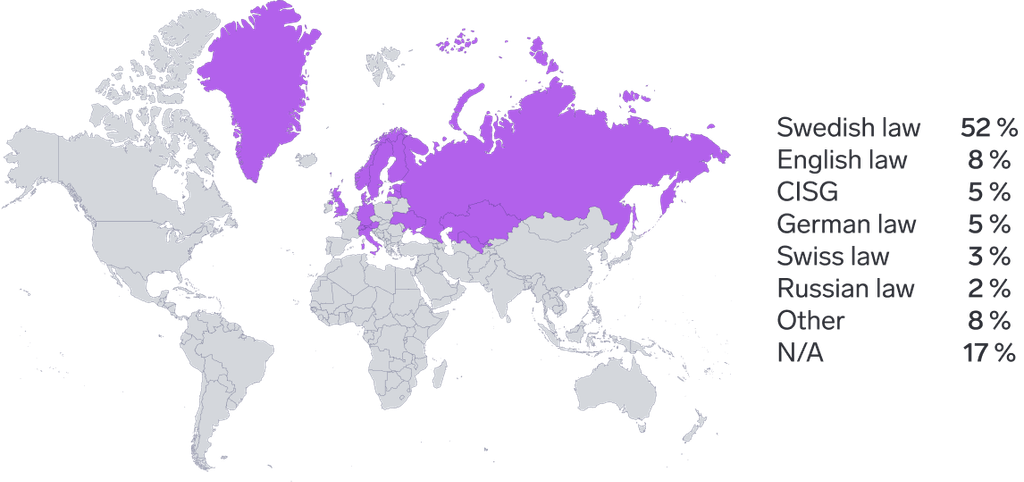
Where a seat was recorded, Stockholm was the seat in 78 per cent of cases, with Malmö (5 per cent), Berlin (3 per cent), and Gothenburg (2 per cent) also featuring, alongside occasional seats in London, Geneva, Singapore, Moscow, Copenhagen, Helsinki, Dubai, Kyiv, and Uppsala. Even where DACH parties were involved on both sides, Swedish law and Stockholm as seat continue to predominate, reflecting the confidence international users place in Sweden's legal framework and its standing as a neutral arbitral seat.
Language of proceedings
English was the language of proceedings in 95 per cent of DACH cases, with Swedish accounting for 3 per cent and Russian for 2 per cent. This near-universal preference for English reflects the international character of the caseload. DACH parties frequently face counterparties from outside the region altogether.
Counterparties
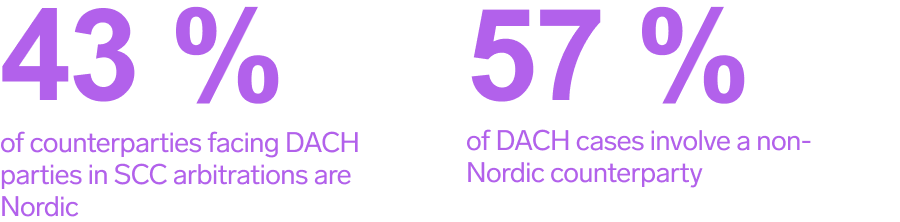
DACH parties at the SCC face counterparties from a broad range of jurisdictions. Nordic parties (predominantly Swedish, but also Danish, Finnish, and Norwegian) appear on the other side in approximately 43 per cent of cases. Russia and Belarus account for a further 19 per cent, and intra-DACH disputes (where both sides are from Germany, Austria, or Switzerland) for 10 per cent. The remaining 28 per cent is spread across more than 20 jurisdictions, including Ukraine, Estonia, Poland, the United States, China, the United Kingdom, Lithuania, Latvia, the United Arab Emirates, and Bulgaria, among others.
While the Nordic relationship remains the single largest source of counterparties, a majority of DACH cases (57 per cent) involve a non-Nordic counterparty. This is consistent with the SCC’s broader positioning as a neutral forum for disputes well beyond the Swedish-DACH trade corridor, and it suggests that the SCC’s appeal to DACH parties rests on institutional reputation and procedural quality, not solely on proximity to a Nordic counterparty.
Duration and efficiency
For the 121 cases that were referred to an Arbitral Tribunal, Mediator, or Arbitrator, the average time from referral to award was 12.2 months, with a median of 10.6 months. By way of comparison, in the SCC's 2025 Annual Statistics, 85.5 per cent of arbitrations concluded under the SCC Arbitration Rules were resolved within 18 months of referral, and 19 per cent within 6 months. The DACH caseload’s duration profile is broadly consistent with these figures.16 This efficiency is a significant factor underlying DACH parties’ preference for arbitration in time-sensitive commercial relationships, including manufacturing supply chains, energy projects, and technology licensing arrangements, where a prompt resolution can be commercially decisive.
Germany in focus: A closer look at the German caseload
As the largest economy in the DACH region and the predominant jurisdiction in DACH disputes at the SCC, Germany warrants closer examination. This section focuses on the 100 German cases within the broader dataset of 170.
Role, counterparties, and governing law
Over the ten years to 2025, the SCC has seen over 100 disputes involving German entities.17 Counterparties are drawn from Russia, Sweden, Albania, Cyprus, Denmark, China, the United Kingdom, the United States, Uzbekistan, Poland, Belarus, and Finland, among others.
Proceedings have been conducted in English, Russian, Swedish, Spanish, and German, seated in Germany, Sweden, Switzerland, Russia, and the United Kingdom, and governed by a correspondingly wide range of laws, including the CISG, and Swedish, German, Italian, Ukrainian, English, Estonian, Swiss, Uzbekistani, and Norwegian law.
These disputes span energy, technology, financial services, construction, retail, manufacturing, life sciences, and mining, with an average amount in dispute of approximately EUR 100 million and awards typically rendered within 13.7 months.
This diversity indicates that German parties do not turn to the SCC solely on account of the strong trade ties between Germany and Sweden. German companies and their advisers select the SCC as a neutral forum for disputes with a genuinely wide range of counterparties18 – a finding that does not surprise Dr Sven Lange, partner at Busse Disputes in Frankfurt and member of the SCC Board:
The SCC offers world-leading dispute resolution services – not just for disputes involving Swedish or Nordic parties, but also for other international disputes. German parties have evidently recognised the capabilities of the SCC and rightly perceive it as a neutral and efficient forum for their international disputes.
On the SCC’s own settlement statistics, German parties are no less likely than other frequent users to resolve their disputes by agreement rather than by award.19
Regional comparison: DACH, Baltic, and Polish caseloads
The DACH caseload can be placed alongside two other regional caseloads examined by the SCC: the Baltic states (Estonia, Latvia, and Lithuania) and Poland. A comparison across these three user communities shows both shared patterns and instructive differences.20
In terms of scale, the DACH caseload is the largest of the three, at 170 cases over the period 2015-2025, compared with 80 Baltic cases and 34 Polish cases. All three caseloads have grown, with registrations roughly doubling between the first and second halves of the decade. The median disputed value is broadly similar across the DACH and Baltic caseloads (EUR 2.26 million and EUR 2.83 million respectively), while the Polish caseload sits somewhat lower at EUR 1.13 million, consistent with a user community centred more on mid-market commercial disputes.
The choice of governing law differs markedly. Swedish law is the single most common choice across all three caseloads, but its share declines from 52 per cent in the DACH caseload to 38 per cent in the Baltic caseload and 29 per cent in the Polish caseload. Conversely, the share of home-country law rises sharply: German law governs only 5 per cent of DACH cases, compared with 21 per cent for Polish law and a striking 50 per cent for Baltic home-country laws (Estonian, Latvian, and Lithuanian law combined). This suggests that Baltic and Polish parties are more inclined to insist on their own substantive law while still selecting the SCC and a Stockholm seat, a combination that presupposes confidence in the institution’s ability to apply unfamiliar legal systems.
Stockholm’s dominance as the seat of arbitration is consistent across all three caseloads, though with some variation: 91 per cent in Baltic cases, 78 per cent in DACH cases, and 74 per cent in Polish cases. English is the near-universal language of proceedings in each caseload (95 per cent DACH, 94 per cent Baltic, and 88 per cent Polish), though the Polish caseload includes three cases conducted in Polish and the Baltic caseload includes occasional proceedings in Swedish and Russian.
The sector mix varies with each region’s economic profile. Energy leads the Polish caseload at 44 per cent and the Baltic caseload at 24 per cent, compared with 18 per cent for the DACH caseload, where retail and consumer products lead. Construction features prominently in the Baltic caseload (22 per cent) but not in the DACH or Polish figures. Duration is broadly comparable: DACH cases average 12.2 months from referral to award, Baltic cases 12.6 months, and Polish cases 9.9 months, the last reflecting both lower average complexity and a high share of emergency arbitrator applications.
Conclusions and outlook
Key findings
The key findings of this Report may be summarised as follows:
- A total of 170 DACH-related cases were registered at the SCC between 2015 and 2025, with the pace of registrations increasing in recent years, from an average of 15 cases per year in 2015-2019 to 23 in 2024.
- The caseload spans a wide range of industries, led over the full decade by retail/consumer products (21 per cent) and energy (18 per cent). The composition has shifted materially between 2015-2019 and 2020-2025: technology, automotive, and mining/metals each gained ground, and the median case value more than doubled between the two periods.
- The aggregate amount in dispute over the decade reached approximately EUR 10.79 billion, although this figure is dominated by a small number of exceptionally high-value cases. Excluding these, the amount in dispute, at an average of EUR 19.1 million and a median of EUR 2.26 million, closely resembles the SCC’s general caseload over the same period.
- Where recorded, Swedish law governed 52 per cent of cases and Stockholm served as the seat in 78 per cent. Sweden remains central where DACH parties are involved.
- Cases referred to the Arbitral Tribunal, Mediator, or Arbitrator were concluded in an average of 12.2 months (median: 10.6 months).
- German parties, in particular, have used the SCC to resolve disputes with counterparties from more than a dozen jurisdictions beyond Sweden, confirming the institution's role as a genuinely international forum for German business rather than merely a venue for German-Swedish disputes.
DACH-related disputes are a substantial and stable part of the SCC's international caseload, one that has grown steadily over the past decade. The German-Swedish trade relationship underpins a significant share of that activity, but the caseload goes well beyond it. The shift toward larger, more complex energy and industrial disputes suggests the caseload will keep maturing, not just growing.
A comparison with the SCC's Baltic and Polish caseloads shows shared patterns - Stockholm's dominance as seat, the prevalence of English, and broadly comparable case durations - alongside instructive differences in governing law preferences and sector composition. The SCC has also made significant efforts to improve accessibility for DACH users, including by publishing its model clauses and the SCC Rules in German (see the Resources section below for direct links).
Outlook
The German Federal Foreign Office continues to describe a close and deepening partnership with Sweden, most recently reflected in the 2025 update to the two countries’ Strategic Innovation Partnership.21 Swedish businesses continue to treat Germany as one of Sweden's most important trading partners. The commercial activity that feeds the SCC’s DACH caseload looks set to keep growing, and the SCC is well placed to meet the dispute resolution needs of this region.
Resources
The SCC Arbitration Rules and model dispute resolution clauses are available in German at the links below.
SCC Arbitration Rules in German
Notes
1 Jake is a dual-qualified lawyer (Australia & Sweden) and Specialist Counsel at the SCC.
2 SCC Arbitration Institute, Annual Statistics Report 2025: https://sccarbitrationinstitute.se/en/about-scc/scc-statistics/
3 See the SCC’s annual statistics, available here: https://sccarbitrationinstitute.se/en/about-scc/scc-statistics/.
4 German Federal Foreign Office, "Sweden": https://www.auswaertiges-amt.de/en/aussenpolitik/sweden-227990
5 Stockholm Chamber of Commerce, "Trade Talks: Germany": https://stockholmshandelskammare.se/events/trade-talks-germany-2/
6 Swedish Chambers International: https://swedishchambersinternational.se/
7 SCC Arbitration Institute, Annual Statistics Report 2025, p. 4: https://sccarbitrationinstitute.se/en/about-scc/scc-statistics/
8 SCC Arbitration Institute, "SCC Spotlight Talk: Christina Ramberg" (11 November 2025): https://sccarbitrationinstitute.se/en/news/scc-spotlight-talk-christina-ramberg/
9 SCC Arbitration Institute, "SCC expands global reach: dispute resolution clauses in more languages" (4 March 2024): https://sccarbitrationinstitute.se/en/news/scc-expands-global-reach-dispute-resolution-clauses-in-more-languages/
10 SCC Arbitration Institute, Annual Statistics Report 2025, p. 4: https://sccarbitrationinstitute.se/en/about-scc/scc-statistics/
11 Raoul J. Sievers, "Evolving Mediation Practices at the SCC Arbitration Institute", Daily Jus (April 2025): https://dailyjus.com/world/2025/04/evolving-mediation-practices-at-the-scc-arbitration-institute
12 SCC Arbitration Institute, "The Settlement Shuffle – Dancing from Dispute to Consensus" (SCC Arbitration Week 2025): https://www.youtube.com/watch?v=k3GzqRbb6z0
13 Falconer, Lowther and Bodin, "The SCC Arbitration Institute - ISDS the Swedish Way".
14 SCC Arbitration Institute, Annual Statistics Report 2025: https://sccarbitrationinstitute.se/en/about-scc/scc-statistics/
15 SCC Arbitration Institute, Annual Statistics Report 2025, p. 7: https://sccarbitrationinstitute.se/en/about-scc/scc-statistics/
16 SCC Arbitration Institute, Annual Statistics Report 2025, p. 11: https://sccarbitrationinstitute.se/en/about-scc/scc-statistics/
17 See the SCC’s annual statistics, available here: https://sccarbitrationinstitute.se/en/about-scc/scc-statistics/
18 See the SCC's annual statistics, available here: https://sccarbitrationinstitute.se/en/about-scc/scc-statistics/
19 Lowther, Sievers and Raivio, "Settlements in cases administered under the SCC Rules" (SCC Arbitration Institute, October 2025).
20 SCC Report: Disputes Involving Baltic Parties in Cases Administered by the SCC (2015-2025); SCC Report: Disputes Involving Polish Parties in Cases Administered by the SCC (2015-2025).
21 German Federal Foreign Office, "Sweden": https://www.auswaertiges-amt.de/en/aussenpolitik/sweden-227990